
“There are days when you wonder what your role is in this country and what your future is in it”(Where). Between 1939 and 1945, World War II was going on and Hitler was the dictator of Germany. During this time the women worked in shops to help supply for the war, while the men worked for the government as soldiers. The gloomy clouds in the skys during the hardship of the war resemble the washed out clothing the citizens wore. The focus of this review is to expand on the soldiers that stayed in Germany to search for the people the immigrants that didn’t fit the perfect utopia Hitler had in mind. Any person that did not love Germany, didn’t have blonde hair and blue eyes went against Hitler’s vision of a person (Gbadamosi). Every person needed to have some type of identification of being German and if not, they were taken away. Many know Hitler for taking Jews, using them for chemical test, starving them, and sending them to concentration camps (which separated families) but many don’t know that Afro-Germans were treated the same (Gbadamosi). Afro-Germans are “biracial people that are descendants of African and German blood” (Where). The Afro-Germans were known as “Hitler’s problem” or “Rhineland bastards” because often their “fathers were African descendants and often absent”(Gbadamosi). The main point of this movie is to expose how Hitler handled the biracial people reproducing themselves and making more; he sterilized them and only few survived the brutal treatment they received. The movie Where Hands Touch, directed and written by Amma Asante exposes German customs during the Holocaust that highlights both tragedty and biracial romance through the setting, dialogue, and appearance.
The movie Where Hands Touch is a romance, drama, and war movie, written and directed by Amma Asante. This movie tells a story about a family with an Afro- German background. Leyna is a colored German. She lives with her mother and her younger brother (Cowin) but both of the children’s fathers are absent. Leyna’s mother and brother are both strictly German. Leyna and her family live in Rhineland, Germany but then move to Berlin so they’re “invisible”, as Leyna’s mother once said (Where). Once the family moved they ran into trouble with the soldiers becoming more harsh, as they did back at home. They were hunting down the Jews like prey that were hidden away. It was very disturbing to see how one group wants to cause genocide on another group because they don’t fit in with the social appearance of blonde hair and blue eyes. Once they came across the Afro-Germans, they were given a hard time because the mothers were sinners for making a black child according to Hitler. Citizens had to have papers to verify that they were German. If they did not have verification and they were caught, they would be thrown onto a shuttle going to a concentration camp as Leyna did. Leyna had false papers which stated she was a German and she was sterilized. She received these papers from her mother’s brother in law (that had access to government papers). Later a soldier burned them because the one paper was the identity of Leyna and could cost her her life.
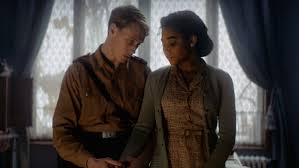
In the meantime, Leyna starts a new school in Berlin but is pulled out as most Afro-Germans were. This pushed Leyna to work with her mother in the factory. The setting that presents Leyna walking through the streets with her mother and experiencing the soldiers embarrassing minorities is devastating because the German soldiers laughat their own hasing. As the movie strolls along, a German soldier caught Leyna’s eye and she caught his. While this is going on, Leyna isn’t sterilized and is not supposed to have any relations with the German males, but she did with the soldier (Lutz). This is against the rules of sterilization. It took a lot of courage for Leyna to take a stand and say she did not want to sign the papers because she is of German blood, but she very calmly signed the papers to avoid any further harm. This part of the film was very touching because it shows how Leyna’s identity was stripped from her when she has to sign papers. It was very beautiful how Leyna and Lutz fall in love and Leyna was impregnated whether German law accept it or not. Not too long after she got pregnant Lutz was sent out on a mission like the rest of the soldiers are and this set a mood of devastation because Leyna was heartbroken after hearing the news. She knew how much of a struggle it would be to safely raise her child on her own.
Later on, Leyna and her mother are walking to work one day and they are stopped by the soldiers and asked for papers. At this point, Leyna doesn’t have any because the soldier burned them. The soldier scolds Leyna’s mother for having a black German and took her away because Leyna’s mother wants to spare Leyna. Leyna then went home and took her younger brother to their aunt’s house for safekeeping and Leyna lived on her own and tried to work. But since the day her mother was taken the soldiers became more harsh but it reveals the independency in Leyna.
Later on, Leyna was caught and taken to a concentration camp just as the Jews were. She grows bigger and bigger as the months pass then came the day she noticed a soldier. The same soldier that caught her eye once before like a kid in a candy store. Lutz did what he could to protect Leyna while she is in the same concentration camp as he is. He gave her more food and gave her more clothes. All along Lutz’s father is stationed at the same concentration camp and notices how Lutz is taking care of her. The way Lutz goes on to protect Leyna is very heartwarming because it proves that race, color or looks, do not determine the goodness and loving character of a person.
As the movie slowly came to an end, the war was coming closer and closer to an end the Germans had to do something to the people in the concentration camps. The soldiers began shooting the people one by one. Lutz wants to save Leyna and the baby from dying. He wants to run away as a typical romance movie would usually do because of the “Happily Ever After” scenario. But Lutz’s father warned him what would happen if he continued on with this type of thinking. Lutz finally found Leyna and Lutz was shot, as expected, by his father. Shot dead right in front of Leyna. This scene was a very emotional scene to watch because it makes the viewer feel as if all hope is lost for Leyna. The only person she had left as a protector and friend was taken from her. All because he cared for someone who was thought to not live up to the “German standards”(Where).
In conclusion, this move is very good and does an exceptional job of depicting how Hitler treated those who did not live up to his expectations of human value. This movie highlights how biracial Germans reproducing was forbidden and how Hitler sterilized them, leaving few to survive his brutal treatment. One of the best parts of this movie was when Amma exposed Hitler on his systematic region with wanting pale skin, blonde hair, and blue eyes. This part shows how Hitler’s mental manipulation of an entire country did not go unnoticed. The setting in Germany really compliments the message Amma gave through Leyna. Leyna continuously showed courage and did what she had to do to survive with her family close or far. This movie is an eye catcher to those that are interested in untold stories about African descendants. This movie aims at those looking forward to be moved by the bravery of young woman looking to make a life for herself and her family and overcome the challenge of simply being her.
Works Cited
Gbadamosi, Nosmot. “Human Exhibits and Sterilization: The Fate of Afro Germans under Nazis.” CNN, Cable News Network, 26 July 2017, www.cnn.com/2017/07/21/world/black-during-the-holocaust-rhineland-children-film/index.html.
“Where Hands Touch Clip – Written and Directed by Amma Asante.” YouTube, YouTube, 14 Sept. 2018, www.youtube.com/watch?v=0tkStIjVwLo.
Where Hands Touch

